








We are committed to protecting your personal data and providing you with access to your personal data in accordance with the personal data protection laws in force in the European Union.
By clicking "Accept All", you are giving us permission to place cookies to enhance your experience on this website, to help us analyze site performance and usage, and to allow us to deliver relevant marketing content. You can manage your cookie settings below. By clicking "Confirm" you agree to the current settings.
According to IMO's statistics, shipping accounts for 80% of global trade and emits over 1 billion tons of CO2 into the atmosphere every year, accounting for about 2.9% of the CO2 emissions worldwide. The shipping industry plays an important role in reducing global carbon emissions. In recent years, the UN Climate Change Conference and EU have called for the control of global warming at 1.5°C, and many international initiatives and organizations have encouraged enterprises to set reduction targets and measures in response to the goal of net-zero emissions by 2050.

Energy Consumption for Organizational Operations
| Energy Type | Calorific Value in 2024 | Calorific Value in 2023 | Calorific Value in 2022 |
|---|---|---|---|
| Diesel fuel(GJ) | 72,231.38 | 73,003.62 | 3,237.99 |
| Gasoline(GJ) | 8,156.18 | 8,539.70 | 545.34 |
| Kerosene(GJ) | 4.98 | 10.68 | - |
| Purchased electricity(GJ) | 91,220.24 | 90,730.15 | 23,703.30 |
| Renewable energy(GJ) | 2,369.34 | 464.51 | - |
| Shore power(GJ) | 49,400.11 | 56,131.92 | 57,197.59 |
| Very Low Sulfur Fuel Oil(VLSFO)(GJ) | 23,394,375.62 | 28,563,539.46 | 33,466,443.04 |
| High Sulfur Fuel Oil(HSFO)(GJ) | 27,285,672.57 | 20,487,932.06 | 14,537,037.11 |
| Ultra Low Sulfur Fuel Oil(ULSFO)(GJ) | 196,565.40 | 383,192.90 | 594,938.22 |
| Marine Gas Oil(MGO)(GJ) | 3,005,667,74 | 2,719,264.53 | 2,956,389.07 |
| Biofuel(B24, B30) | 2,433,074.70 | - | - |
| Total (GJ) | 56,538,738.26 | 52,382,809.53 | 51,639,486.66 |
| Annual consolidated operating revenue(NT$ million) | 222,705.949 | 140,623.713 | 375,899.874 |
| Energy use intensity(GJ/NT$ million) | 253.87 | 372.50 | 137.38 |
| Heavy fuel oil total energy(GJ) | 53,309,688.29 | 49,434,664.42 | 48,598,418.37 |
| Percentage of heavy fuel | 94.29% | 94.37% | 94.11% |
| Percentage of renewable energy | 0.004% | 0.001% | - |
Energy Saving Strategies
 Onshore business locations |
|
 Reefer containers |
|
 Fleet |
|
2024
Fuel Consumption
0 Ton
2023
Fuel Consumption
0 Ton
2022
Fuel Consumption
0 Ton
Management of the Fleets' Carbon Emissions
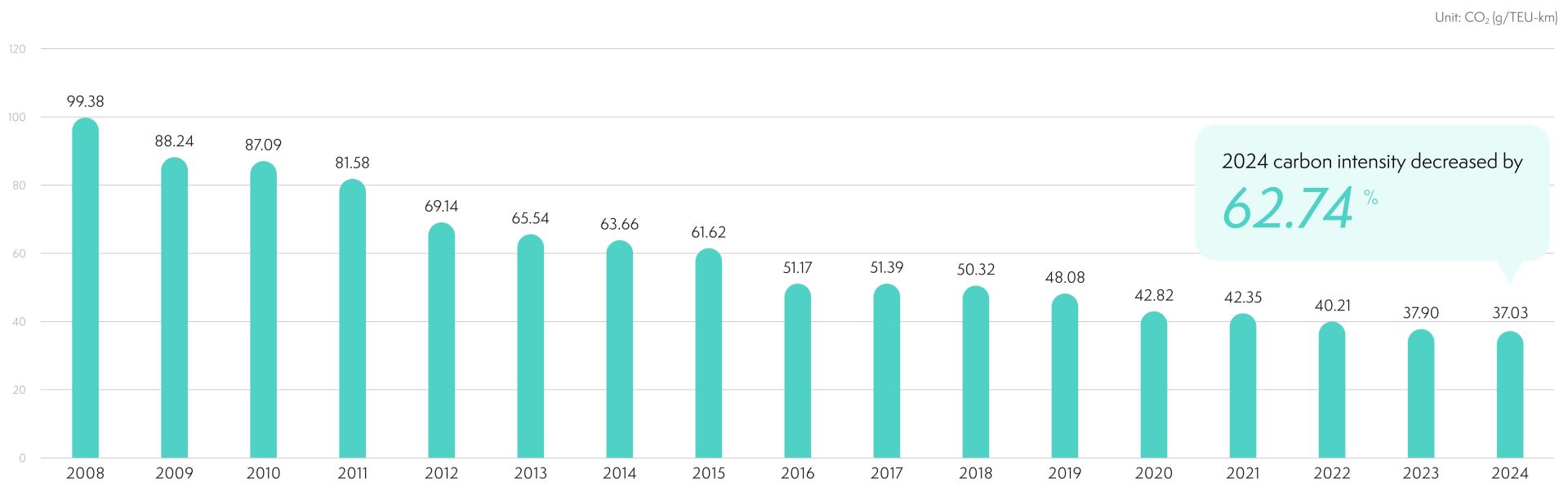
Yang Ming continues to go above and beyond international regulatory requirements by adopting management measures such as hull optimization, the introduction of new eco-friendly ships, optimal ship speed control, the use of smart monitoring systems, and the modification of existing ships. The carbon intensity of the operating ships in 2024 was 37.03 g/teu-km, reducing by 62.74% compared to 2008, early attaining IMO's goal of a 40% reduction by 2030.
Carbon Intensity Performance of the Fleet
The carbon intensity was reduced by 0.87 g/TEU-km, showing a 2.30% improvement.
COUNTERMEASURES
In response to the Paris Agreement and global carbon reduction strategies, the International Maritime Organization (IMO) has approved amendments to Annex VI of the International Convention for the Prevention of Pollution from Ships (MAPOL) and passed two new regulations, requiring that ships applicable from January 1, 2023 must calculate the "Energy Efficiency Existing Ship Index (EEXI)" and the "Carbon Intensity Indicator (CII)." EEXI is a technical measure and CII is an operational measure adopted for the reduction of emissions from ships. Through calculating "Carbon Intensity Indicator (CII)," poorly performing vessels must formulate corrective plans and incorporate them into Ship Energy Efficiency Management Plan (SEEMP).
The Company internally established a CII Task Force in September 2022, including technical, vessel, liner planning, and operations planning units. In addition to conducting cross-departmental discussions according to EEXI regulations to arrange appropriate inspection schedules and reduce vessel carbon emissions based on maximum horsepower restrictions after implementation; inventory each vessel's CII rating on routes, monitor CII rating changes and annual fuel consumption in real-time through digital tools, and hold regular monthly meetings to discuss the timing of using 21 rating optimization measures for each vessel. For vessels with poor ratings, conduct cause analysis and adopt different improvement measures for targeted solutions, with each vessel's CII rating targeting C-level as the annual goal.
The following are the measures adopted by the Company in response to the EEXI and CII:
| Issue/Regulation Description and Planning | Energy Efficiency Existing Ship Index (EEXI) EEXI must be submitted to Classification Society for approval to obtain International Energy Efficiency Certificate (IEEC certificate, same as EEDI, one-time verification). |
Carbon Intensity Indicator (CII) Annual calculation and reporting of annual CII value, with annual rating from A-level to E-level. If a vessel falls into D-level for 3 consecutive years or E-level for 1 year, a corrective plan must be formulated. |
| Suggested Improvement Methods from Classification Societies |
|
|
| Yang Ming’s Practices |
|
|
New Ships' EEDI
| Name/Model of New Ship | 2013~2024 delivery quanity (vessels) | EEDI (gCO2/ton-Nm) |
|---|---|---|
| E+ type | 5 | 16.22 |
| C type | 10 | 15.70 |
| W1 type | 10 | 9.22 |
| W2 type | 5 | 8.88 |
| W3 type | 5 | 8.52 |
| T1 type | 5 | 8.06 |
| T2 type | 9 | 7.87 |
| Average | 10.78 | |
GHG INVENTORY
Yang Ming has actively promoted green shipping. In 2021, the Company introduced the ISO 14064-1 GHG inventory and acquired third-party verification. Based on the inventory results, we have promoted and planned the setting of GHG emission reduction targets and measures for the Company. The Company continues to complete the ISO14064-1 GHG inventory for the ships owned and operated by the Company every year, and has introduced the GHG Protocol Corporate Standard, been certified to ISO 14064-1 and the GHG Protocol, and obtained certification from the Taiwan Accreditation Foundation.

Scope 1
Category1
Direct emissions
Emissions(tCO₂e)
4,356,300.6872

Scope 2
Category2
Indirect GHG emissions from imported energy
Emissions(tCO₂e)
17,032.6671
GHG emissions from vessels

Total scope 1 and 2 emissions
4,373,333.3543
(tCO2e)
Scope 3

Category3
Indirect GHG emissions from transportation
Emissions(tCO₂e)
1,588.1372

Category4
Indirect GHG emissions from the Company's use of products
Emissions(tCO₂e)
1,186,550.6676

Category5
Indirect GHG emissions from the use of the Company's products
Emissions(tCO₂e)
45,326.7864