


We are committed to protecting your personal data and providing you with access to your personal data in accordance with the personal data protection laws in force in the European Union.
By clicking "Accept All", you are giving us permission to place cookies to enhance your experience on this website, to help us analyze site performance and usage, and to allow us to deliver relevant marketing content. You can manage your cookie settings below. By clicking "Confirm" you agree to the current settings.
Climate Change Governance Strategies
Natural and Climate Change Governance Strategy

The World Economic Forum's "2024 Global Risks Report" indicates that extreme weather disasters rank second among short-term risks, and if the timeframe is extended to the next decade, the top four risks are all related to climate and environment. Recent environmental regulations and policies strengthened by various countries (such as carbon tax collection), as well as physical impacts that may be caused by climate change risks themselves (such as: canal water level drops that may require vessels to detour or use other transshipment methods for transportation, operational equipment damage that may be caused by earthquakes, disasters brought by floods, etc.), are all issues that need attention regarding climate change.
Climate Sustainability Governance
Yang Ming's Board of Directors serves as the highest climate governance body, responsible for supervising and deciding on related policies, strategies, and targets, and managing climate-related risks and opportunities and promoting related affairs through the Risk Management Committee and Sustainable Operation Strategy Team. After annual Group climate-related risk and opportunity identification is completed, assessment results are reported to the Board of Directors and Risk Management Committee. Additionally, the Sustainable Operation Strategy Team's annual climate-related target execution status is reported to the Board of Directors for approval at least once a year to strengthen our response measures to various climate issues and resilience to risks.
Natural and Climate Change Governance Organizational Structure and Segregation of Duties
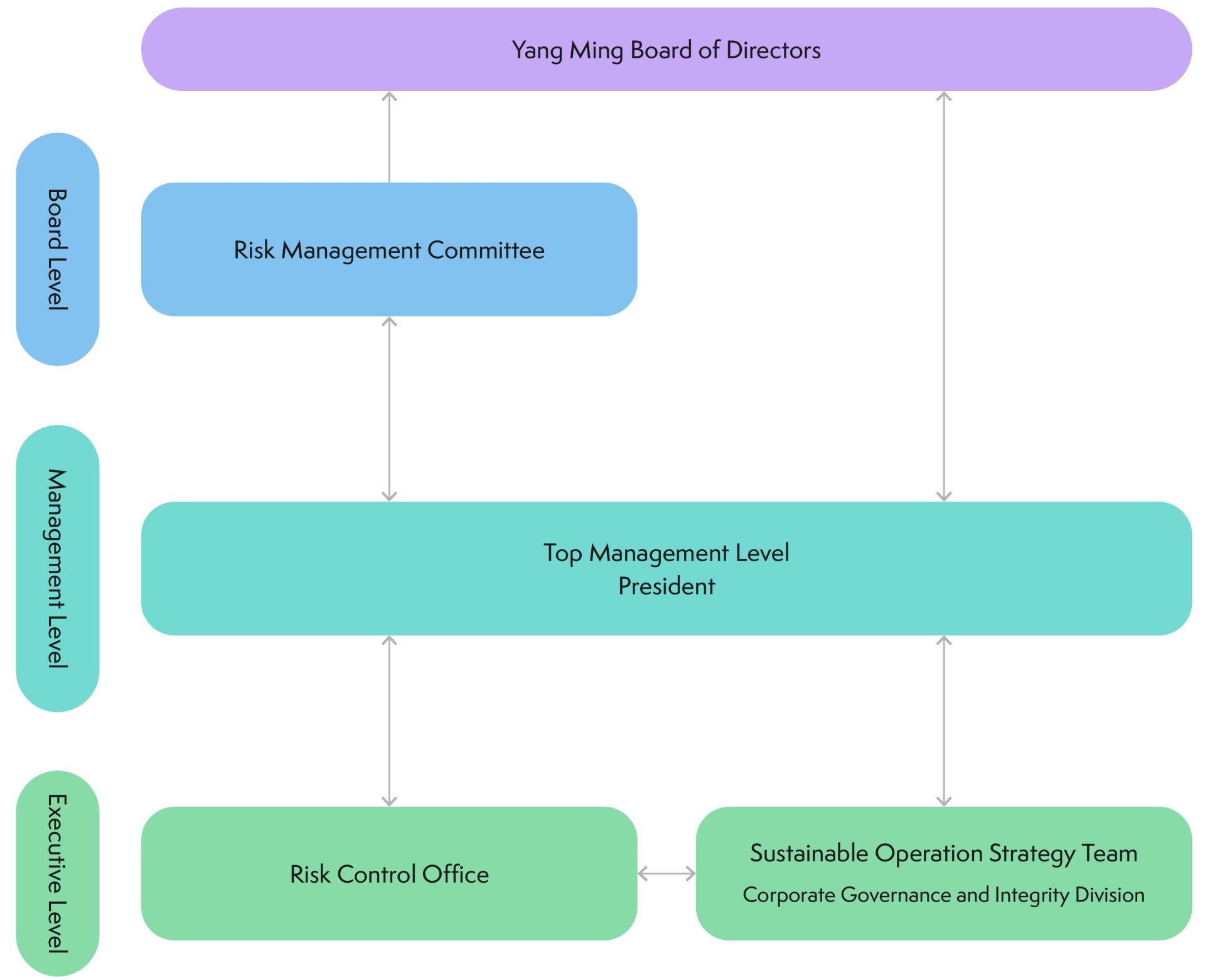
| Board Level |
Board Directors |
|
At least once per quarter |
| Risk Management Committee |
|
At least once per quarter | |
| Management Level | President |
|
At least once per quarter |
| Executive Level | Sustainable Operation Strategy Team - Corporate Governance and Intergrity Division |
|
At least once per year |
| Risk Control Office |
|
Quarterly reporting |
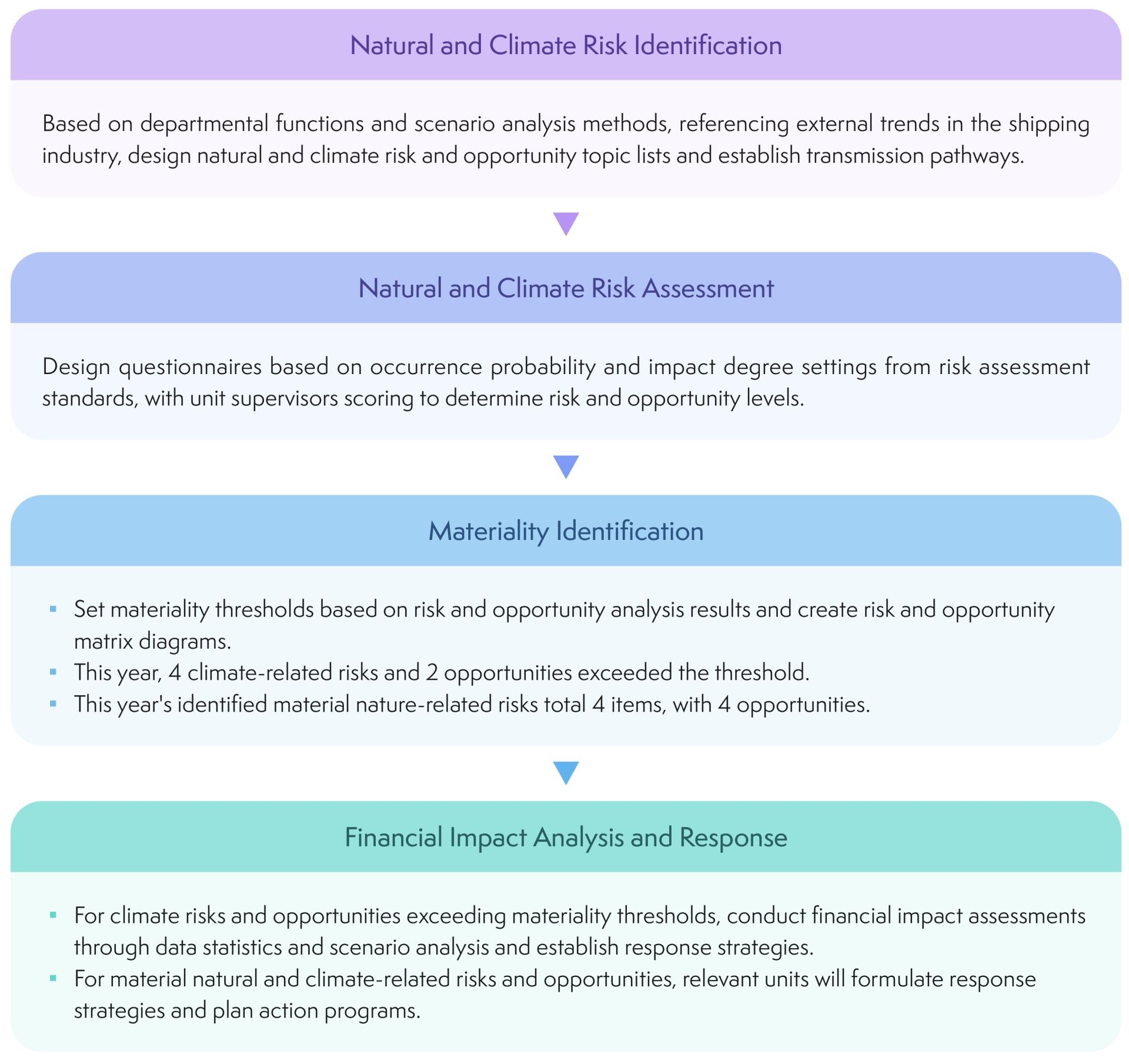
Natural and Climate-Related Risks and Opportunities Management Process
To effectively manage natural and climate risks and opportunities that the Company may face in overall operations, the Sustainable Operation Strategy Team incorporates natural and climate change-related risks into assessment and tracking scope, continuously monitoring risk events that may impact Company operations, while focusing on opportunities that natural capital and climate change may bring to the Company. For identified natural and climate risk issues with substantial material impact, they will be incorporated into assessment and tracking scope, with assessment results provided to management and the Board of Directors for operational decision-making and supervisory reference.
Material Climate-Related Risks and Opportunities
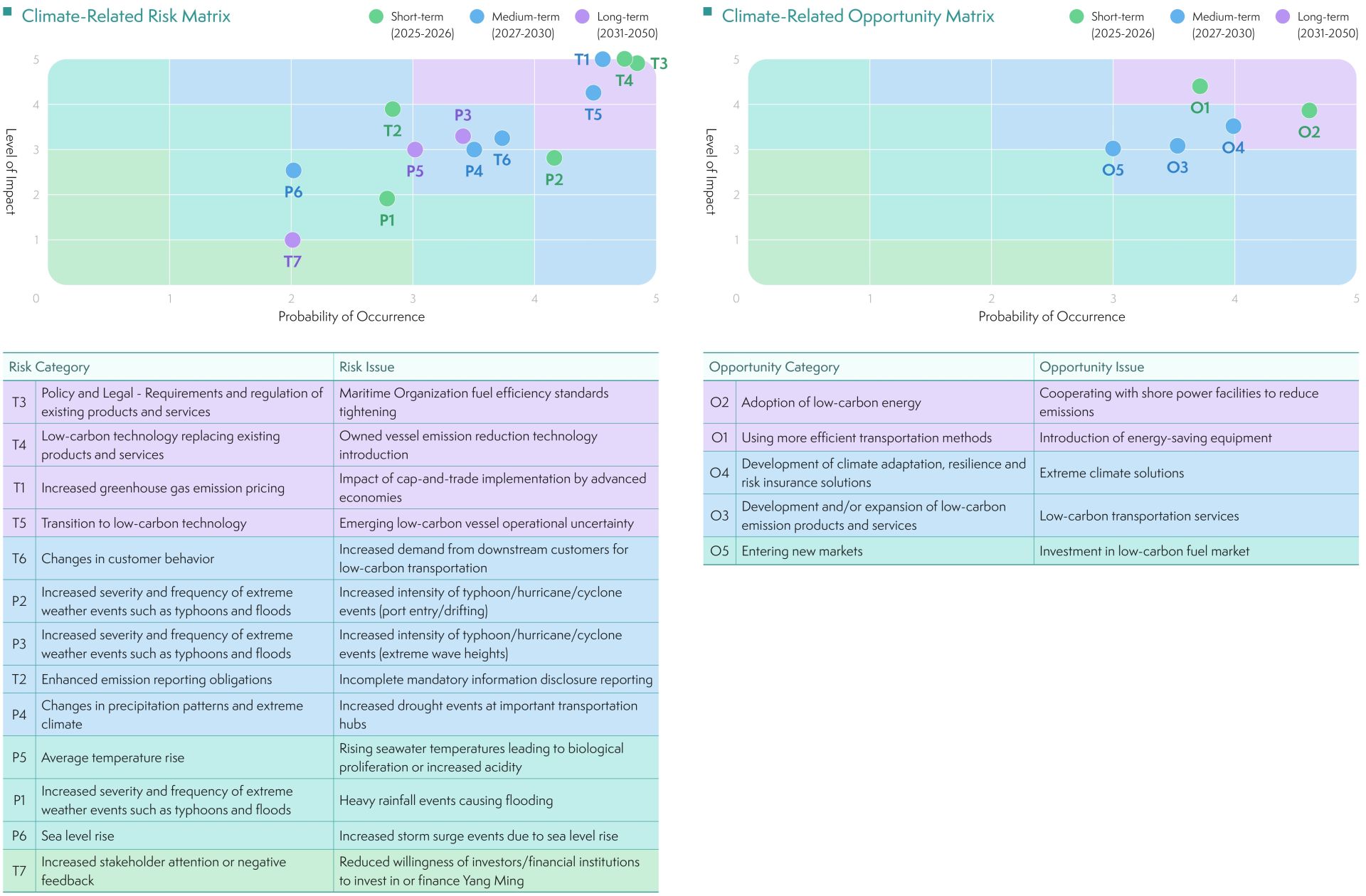
Based on climate-related risk ranking results, we have 4 material risks and 2 material climate opportunities exceeding the significance threshold. Considering stakeholder concern about physical risks, we additionally include the highest-ranking physical risk and identify potential financial impacts, occurrence timing, and impact scope of related risks and opportunities as reference for determining future Company climate change-related countermeasures.
| Order | Risk Category | Risk Issue | Risk Description | Occurrence Time | Impact Scope | Potential Financial Impact | |
| 1 | T3 | Policy and Legal - Requirements and regulation of existing products and services | Maritime Organization fuel efficiency standards tightening | IMO short-term measures CII for actual operational efficiency rating and EU FuelEU regulations, medium-term implementation of Goal Based Marine Fuel Standard (GFS), economic measures taken may impact Yang Ming's fuel expenditure. | Short-term | Operating vessels | Increased operating costs due to increased alternative fuel usage and fuel price differences |
| 2 | T4 | Technology - Low-carbon technology replacing existing products and services | Owned vessel emission reduction technology introduction | For Yang Ming's owned operating vessels requiring energy-saving technology measures introduction (such as main engine adjustments, hull modifications, etc.), equipment expenditure may increase. | Short-term | Operating vessels | Installing energy-saving equipment or vessel modifications will increase capital expenditure |
| 3 | T1 | Policy and Legal - Increased greenhouse gas emission pricing | Impact of cap-and trade implementation by advanced economies | Affected by cap-and-trade implementation by advanced economies, routes operating in regulated areas may need to purchase certificates to pay related fees. | Medium-term | Operating vessels - European routes | As emission trading system coverage increases and certificate unit prices rise, if unable to pass through costs successfully, operating costs will increase |
| 4 | T5 | Technology - Transition to low-carbon technology | Emerging low-carbon vessel operational uncertainty | In response to International Maritime Organization net-zero emission trends, heavy oil vessels will gradually be replaced by new energy fuel vessels in the short term, increasing capital expenditure for new energy fuel vessels. | Medium-term | Operating vessels | New low-carbon emission vessel construction may increase capital expenditure |
| 5 | P2 | Acute - Increased severity and frequency of extreme weather events such as typhoons and floods | Increased intensity of typhoon/hurricane/ cyclone events (port entry/drift) | Strong winds from typhoons may prevent vessels from smoothly entering ports or limit container yard equipment operations. May delay cargo unloading and loading operations, affecting transportation efficiency. Additionally, due to navigation restrictions, vessels may need to detour or dock at other ports, increasing fuel consumption and pushing up fuel costs. | Short-term | Operating vessels | Vessels need to detour or increase sailing time, leading to increased fuel consumption |
| Order | Opportunity Category | Opportunity Issue | Opportunity Description | Occurrence Time | Impact Scope | Potential Financial Impact | |
| 1 | O2 | Energy Source - Adopting low-carbon energy | Cooperating with shore power facilities to reduce emissions | For port phases, Yang Ming continues to cooperate with shore power policies, which not only reduces greenhouse gas emissions but also reduces fuel costs during port berthing. | Short-term | Operating vessels/ operating ports | Using shore power not only cooperates with policies to reduce berthing fuel costs but may also reduce additional certificate expenditure when used at European ports |
| 2 | O1 | Resource Efficiency - Using more efficient transportation methods | Introduction of energy-saving equipment | Through energy-saving equipment to improve vessel energy consumption performance, thereby reducing fuel usage, enabling Yang Ming to save fuel costs and reduce carbon emissions. | Short-term | Operating vessels | Reducing fuel consumption through energy saving equipment can reduce operating costs |
Climate Scenario Analysis
To understand the financial impacts of climate change on the shipping industry, we conduct quantitative analysis research and discussions of different scenarios, performing scenario analysis on our main core business operations including vessel routes, port operations, business operations, and related value chains, further evaluating resilience methods and developing response measures. We reference climate scenarios published by international organizations, including the "Intergovernmental Panel on Climate Change (IPCC)" and "International Energy Agency (IEA)," and additionally consider "International Maritime Organization (IMO)" targets at different time points for assessment to develop response strategies for various risk and opportunity issues.
| Value Chain | Scenario Description | Risk Category | Corresponding Risk/Opportunity Issue | Reference Scenario | Analysis Time Point |
 Operating Vessels |
Scenario1 International Maritime Organization complying with its policies and targets |
Transition risk | T3 |
|
Short-term ~ Medium-term |
| Scenario2 Shipping industry needs to introduce emission reduction technology and operate new energy vessels |
Transition risk | T4/T5/O1/O2 | Short-term ~ Medium-term | ||
| Scenario3 Advanced economies carbon certificate price growth |
Transition risk | T1 | Medium-term | ||
| Scenario4 Fleet operational impacts of typhoons/hurricanes/ cyclones under climate change |
Physical risk | P2 |
|
Short-term |
*Each scenario considers temperature rise in mid-21st century.
Operating Vessel Scenario Analysis
| Scenario1 International Maritime Organization complying with its policies and targets | |
| Corresponding Risk Event | T3 Maritime Organization fuel efficiency standards tightening |
| Scenario Assumption Background | According to the "Initial IMO Strategy on Reduction of GHG Emissions from Ships" formulated by the 72nd Marine Environment Protection Committee (MEPC) under the International Maritime Organization, and maintained at the 80th session, Yang Ming's operating vessels are committed to reducing unit transportation carbon emissions and tracking ratings of operating vessels through Carbon Intensity Indicator (CII). The Company adopts policy assumptions for the maritime sector in IEA NZE scenario, evaluating that if the Maritime Organization continues to tighten CII indicators, additional biofuel costs will need to be incurred to respond. |
| Risk Aspect Assessment | To meet IMO short-term and medium-term carbon intensity reduction targets, expanding procurement of B24 or B30 biofuel is the main approach to achieve targets. Based on estimated expanded biofuel procurement volumes, short-term operating costs will increase, with medium-term operating cost increases higher than short-term. |
| Response Strategy |
|
| Scenario2 Shipping industry needs to introduce emission reduction technology and operate new energy vessels | |
| Corresponding Risk Event | T4 Owned vessel emission reduction technology introduction T5 Emerging low-carbon vessel operational uncertainty O2 Cooperating with shore power facilities to reduce emissions O1 Introduction of energy-saving equipment |
| Scenario Assumption Background | According to the IMO Fourth GHG Study report, besides promoting alternative fuels, improving fuel efficiency and adjusting operational modes can also reduce fuel usage for transportation services. IEA NZE scenario estimates show that if IMO achieves 2030 targets, biofuel energy demand should reach 10%, low-emission methanol 8%, hydrogen fuel 4%, requiring shipping operators to plan heavy oil fleet replacement programs. |
| Risk Aspect Assessment |
|
| Response Strategy |
|
| Scenario3 Advanced economies carbon certificate price growth | |
| Corresponding Risk Event | T1 Impact of cap-and-trade implementation by advanced economies |
| Scenario Assumption Background | The EU Emissions Trading System has incorporated the shipping industry into cap-and-trade scope, requiring vessels entering and leaving EU ports to pay certificate fees to comply with relevant regulations. Starting from 2026, all emissions will be included in EU ETS collection scope. According to Net Zero Emissions (NZE) estimates, carbon certificate prices in advanced economies are expected to be approximately 140 USD/t-CO2e in 2030, potentially reaching 200 USD/t-CO2e in 2050. |
| Risk Aspect Assessment | This analysis focuses on European routes (NEA/NEL/FE4/FP2/MD1/MS2/IBX) as the main impact scope. If starting from 2026, 100% of greenhouse gas emissions are included in collection scope and considering carbon price growth trends in international literature, operating costs are expected to increase. |
| Response Strategy | Domestic and international regulatory trend tracking:Relevant units regularly provide, track, and update EU and national environmental protection, carbon tax, and other regulatory details and changes to enable operating units to respond appropriately. |
| Scenario4 Fleet operational impacts of typhoons/hurricanes/cyclones under climate change | |
| Corresponding Risk Event | P2 Increased intensity of typhoon/hurricane/cyclone events (port entry/drift) |
| Scenario Assumption Background | Under SSP5-8.5 worst-case scenario, although the number of typhoons affecting Taiwan decreases, the proportion of strong typhoons will double, maximum wind speeds will increase by 4%, potentially approaching Level 17 gusts. For major route affected areas in the Western Pacific, North Atlantic, and North Indian Ocean regions, the expected number of typhoons will decrease, but the proportion of strong typhoons will increase. |
| Risk Aspect Assessment | Due to port closures caused by extreme weather, vessel stay times are extended, leading to increased fuel consumption. Statistics show that annual port closures due to typhoons or strong winds cause vessels to be delayed 4-5 days, generating additional fuel costs. |
| Response Strategy |
|
Material Nature-Related Risks and Opportunities
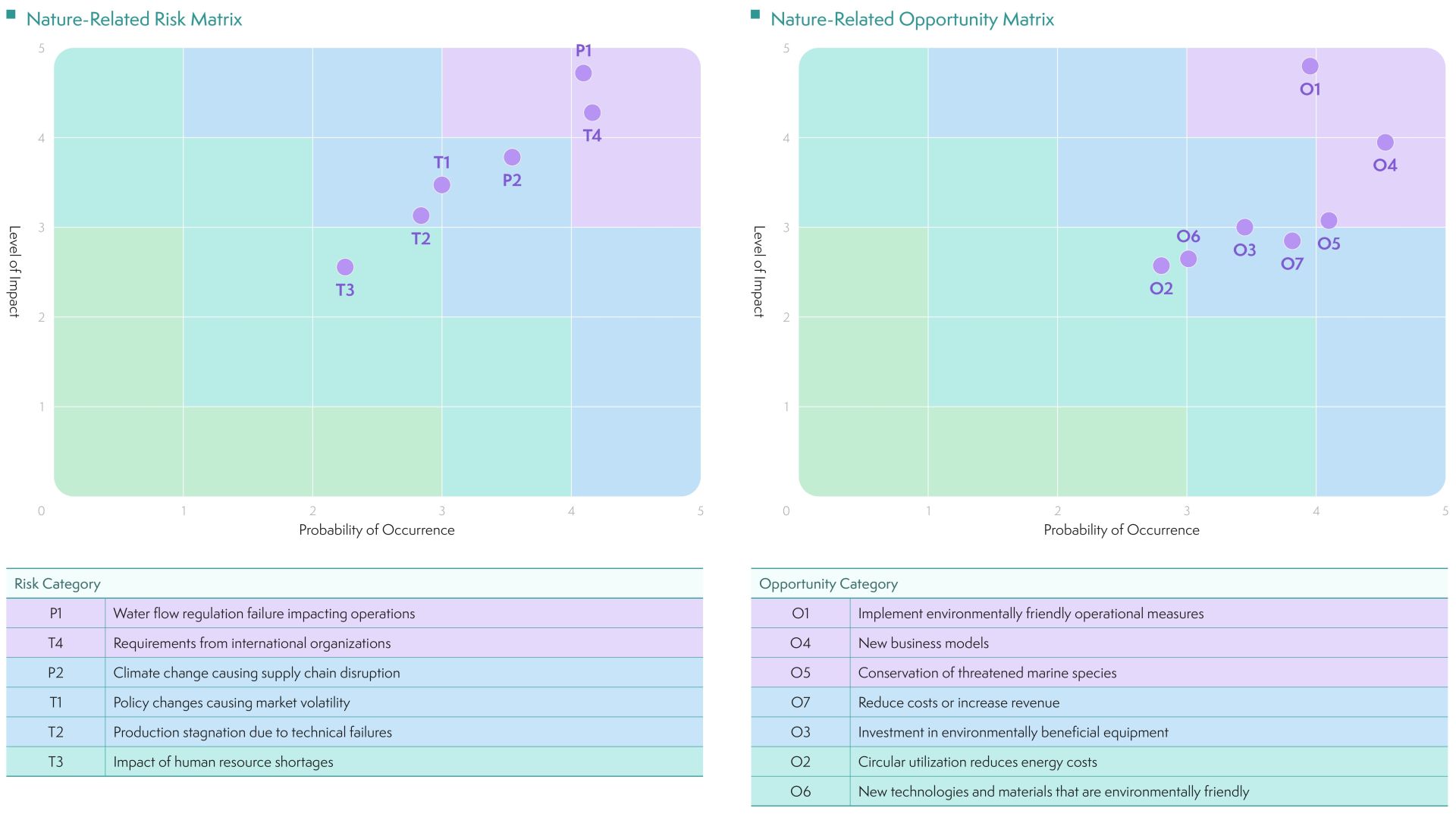
To manage nature-related risk and opportunity issues faced by the Company's business activities during operations, we adopt the LEAP (Locate/Evaluate/Access/Prepare) methodology steps. Based on material dependencies and impact items identified in the Evaluate phase, considering actual navigation operational events and current international regulatory policies, and from TNFD shipping industry draft guidelines regarding dependencies and impact pathways, we identify how ecosystem services and impact drivers generate nature-related risks and opportunities.
Then in the Assess phase, we conduct material nature-related risk and opportunity identification, along with recommendations from departments related to vessel/route planning within the Sustainable Operation Strategy Team, evaluating the occurrence probability and impact degree of various nature-related risks. Finally, we create risk and opportunity matrices using occurrence probability and impact degree dimensions to rank material risk and opportunity issues. This year's identified material nature-related risks total 4 items with 4 opportunities, and corresponding strategic responses are proposed.
| Material Issues | Impact Content | Risk/Opportunity Category | Response Strategy | |
| T4 | Requirements from international organizations | Must comply with net-zero carbon emission targets set by international organizations and respond to environmental pollution responsibilities in ship recycling processes. | Transition risk | Participate in industry international organizations and comply with international conventions, implement net-zero carbon emissions in phases |
| P1 | Water flow regulation failure impacting operations | Such as drought causing route diversions and cost increases. | Physical risk |
|
| P2 | Climate change causing supply chain disruption | Affects port operations, increases accidents, container losses, and raises operating costs. | Physical risk |
|
| T1 | Policy changes causing market volatility | Markets experience price changes due to environmental regulation changes. | Transition risk |
|
| O4 | New business models | Use alternative fuels to reduce transportation carbon emissions for vessels, creating new market services. | Opportunity |
|
| O5 | Conservation of threatened marine species | Corporate investment in marine environmental restoration programs helps maintain marine environment and benefits corporate reputation. | Opportunity |
|
| O1 | Implement environmentally friendly operational measures | Slow sailing reduces biological collisions, decreases underwater noise, reduces air emissions, and lowers fuel costs. | Opportunity |
|
| O7 | Reduce costs or increase revenue | Port fee discounts or participation in competitions, enhancing corporate reputation. | Opportunity |
|