




We are committed to protecting your personal data and providing you with access to your personal data in accordance with the personal data protection laws in force in the European Union.
By clicking "Accept All", you are giving us permission to place cookies to enhance your experience on this website, to help us analyze site performance and usage, and to allow us to deliver relevant marketing content. You can manage your cookie settings below. By clicking "Confirm" you agree to the current settings.
Material Topic Identification Process
Identification of Material Sustainability Topics Process:
STEP1
Master sustainability issues
Through understanding organizational context and referencing international sustainability trends, regulations and standards (GRI Standards, shipping industry guidance in the SASB Standards, SDGs, TCFD, etc.), United Nations Sustainable Development Goals, sustainability investment evaluations (DJSI, MSCI, CDP) and International Maritime Organization (IMO) disclosure requirements, and considering industry disclosure status, compiled 23 sustainability issues related to Yang Ming's operational activities in 2024.
STEP2
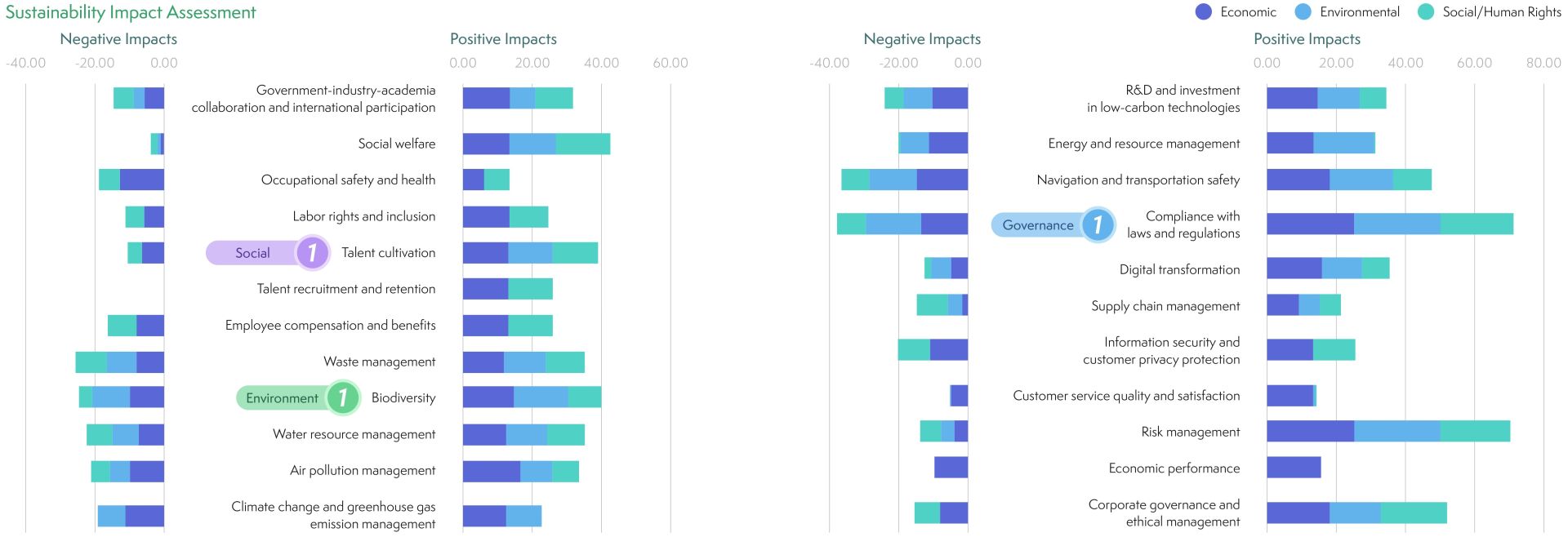
Assess Positive and Negative Impacts of Sustainability Issues
The 23 issues were made into a sustainability impact assessment questionnaire, with feedback from 34 issue-related departments and expert scholars, evaluating the impact of each issue on economic, environmental, and social/human rights aspects, including positive/negative impact degree and actual/potential likelihood of occurrence.
STEP3
Assess the Operational Impact Degree of Sustainability Issues on the Company
The 23 issues were made into an operational impact assessment questionnaire, with feedback from 34 departments and expert scholars, evaluating the financial impact degree and importance level of each issue on company operations.
STEP4
Understand Stakeholders' Level of Concern for the Company's Sustainability Issues
The 23 issues were made into a stakeholder concern questionnaire, with 282 valid questionnaires collected, understanding stakeholders' focus of concern for Yang Ming through statistical results.
STEP5
Material Issues Determination
- Through a comprehensive assessment of "sustainability impact materiality" and "operational (financial) impact materiality," and with emphasis on stakeholder’s feedback, Yang Ming 's material issues for 2024 were selected and approved by the Board of Directors.
- The topics with the greatest sustainability impact in each dimension - governance, environmental, and social - are prioritized, including three material issues: " Compliance with laws and regulations," "Biodiversity," and "Talent cultivation".
- Subsequently, by referencing both operational impact assessments and stakeholder concern results, topics that ranked higher in the comprehensive evaluation were internally screened and 7 material issues were included: "Navigation and transportation safety," "Corporate governance and ethical management," "R&D and investment in low-carbon technologies," "Energy and resource management," "Climate change and greenhouse gas emissions management," "Occupational safety and health," and "Information security and customer privacy protection."
STEP6
Setting Material Issue Impact Boundaries, Impact Description and Management Approaches
Yang Ming is well aware that in making positive contributions to sustainable development, negative impacts may be generated in operating activities and acknowledges that the positive and negative impacts cannot be offset by each other. Therefore, when reporting on various sustainability issues, relevant responsible units re-examine the actual/potential positive and negative impact scope caused by the issue from the actual implementation perspective, formulating further material topic management approaches.
MATERIALITY ISSUES
★:Material Topics
★
Compliance with laws and regulations
★
Navigation and transportation safety
★
Corporate governance and ethical management
★
Information security and customer privacy protection
Economic performance
Risk management
Customer service quality and satisfaction
Supply chain management
Digital transformation
★
R&D and investment in low-carbon technologies
★
Biodiversity
★
Energy and resource management
★
Climate change and greenhouse gas emissions management
Air pollution management
Water resource management
Waste management
★
Talent cultivation
★
Occupational safety and health
Employee Compensation and Benefits
Talent recruitment and retention
Labor rights and inclusion
Social welfare
Government-industry-academia collaboration and international participation
MATERIAL ISSUES
Yang Ming is well aware that in making positive contributions to sustainable development, negative impacts may be generated in operating activities and acknowledges that the positive and negative impacts cannot be offset by each other. Hence, in reporting the sustainability topics, relevant responsible units once again reviewed the actual/potential positive or negative impacts of the topics from the perspective of actual implementation to further develop management approaches for the material topics.
01 Compliance with laws and regulations
GRI Topic
- GRI 2 General Disclosures
SASB Index
- TR-MT-540a.2
- TR-MT-540a.3
Significance to Yang Ming
- Yang Ming strictly adheres to regulations and laws, implementing them in daily operations through internal policies and advocacy.
Impact Description (Economic/Environmental/People or Human Rights)
【Positive】
Actual Impact, Potential Impact: Ensuring operational behavior complies with legal norms, enhancing trust from partners, and reducing risks of trade disputes, promoting long-term stable cooperation, can positively impact economic development.
【Negative】
Potential Impact:
Actual Impact, Potential Impact: Ensuring operational behavior complies with legal norms, enhancing trust from partners, and reducing risks of trade disputes, promoting long-term stable cooperation, can positively impact economic development.
【Negative】
Potential Impact:
- Business affected by trade disputes, legal litigation, regulatory violations, or market bans may lead to customer interests being damaged, further affecting customer trust in the market.
- Failure to strictly comply with environment related regulations, leading to environmental pollution or waste problems, poses threats to coastal ecology and residents' health.
- Failure to fulfill legal obligations, infringement of workers' rights may cause physical or mental harm to workers, even affecting their families. If it attracts social attention, it may trigger strong reactions from labor groups, social movement organizations, or media.
Position of the Impact of Sustainability Issues in the Value Chain
- Upstream
- Yang Ming
- Downstream
Corresponding Chapter
- 2.3 Compliance Governance and Internal Audit System
Management Goals for Material Topics
| Policies and commitments | Stakeholders | 2024 goals and achievements | Short/medium/long-term goals | Action Response Chapters |
| Yang Ming has established a Legal Compliance Office to oversee regulations and laws in Taiwan, China, the EU, the United States, and other important regions, and actively participates in external organizations to stay informed of the latest information and regulations, continuously monitoring and advocating, and timely adjusting operational behavior to ensure compliance with legal norms. |
|
Goal: No occurrence of major regulatory violations Performance: No major regulatory violations occurred in 2024 |
2025: Complete IFRS implementation according to the Taiwan Stock Exchange regulatory schedule, implement personal data protection policies, include privacy protection in internal audit items 2030: Maintain effectiveness of internal control systems, implement information security management 2050: Strengthen integrity management mechanisms, enhance information transparency and awareness |
2.3 Compliance Governance and Internal Audit System |
| Goal: Reduce the number of vessel condition deficiencies Performance: Port State Control (PSC) inspected vessel deficiency rate increased by 17.8% compared to 2023, with 40 vessel supervision visits, 262 circulars sent, and monthly inspection and drill records checked for each vessel in 2024 Analysis of cause: Increased inspection frequency, expanded inspection scope, stricter inspection standards (regulations, etc.), crew personnel changes, vessel aging and inadequate maintenance, etc. |
2025: Self-managed fleet vessels detained by external (PSC) inspections due to improper management causing safety issues, target value ≤2 times/year 2030: Port State Control (PSC) inspected vessels have no serious deficiencies or detention incidents 2050: Implement navigation and transportation safety |
02 Navigation and transportation safety
GRI Topic
- GRI 403 Occupational Health and Safety
SASB Index
- TR-MT-540a.1
Significance to Yang Ming
- Shipping safety is the company's commitment to employees and customers.
Impact Description (Economic/Environmental/People or Human Rights)
【Positive】
Potential Impact:Implementing ship safety management, conducting risk assessment operations, controlling and reducing hazards caused by shipping accidents, improving service stability, can positively impact economic development while ensuring employee life safety.
【Negative】
Potential Impact:Failure to implement ship safety management may harm employee health and safety. Meanwhile, ship risks exceeding controllable range easily trigger shipping accidents, thereby damaging customer interests and weakening partner trust. Additionally, if ship leakage incidents occur, they will cause long-term negative impacts on marine ecosystems, further affecting coastal residents and local industry development.
Potential Impact:Implementing ship safety management, conducting risk assessment operations, controlling and reducing hazards caused by shipping accidents, improving service stability, can positively impact economic development while ensuring employee life safety.
【Negative】
Potential Impact:Failure to implement ship safety management may harm employee health and safety. Meanwhile, ship risks exceeding controllable range easily trigger shipping accidents, thereby damaging customer interests and weakening partner trust. Additionally, if ship leakage incidents occur, they will cause long-term negative impacts on marine ecosystems, further affecting coastal residents and local industry development.
Position of the Impact of Sustainability Issues in the Value Chain
- Upstream
- Yang Ming
- Downstream
Corresponding Chapter
- 4.1 Navigation and Transportation Safety
- 5.4 Occupational Safety and Health
Management Goals for Material Topics
| Policies and commitments | Stakeholders | 2024 goals and achievements | Short/medium/long-term goals | Action Response Chapters |
| Provide safe and reliable transportation services, implement shipping safety, and pass on the three core corporate values, safety and security of vessels, personnel, and cargos. |
|
Goal: Safe and reliable transportation services Performance: Zero container loss overboard and container collapse incidents, zero errors in special cargo safety control, implemented 7,783 checks for vessel stability, cargo stowage and safety securing (pre-planned), fully utilized Weathernews Inc. safety navigation with weekly review meetings for 52 weeks, participated in WSC-TopTier international seminars 3 times |
2025: Zero containers lost at sea or collapsing and zero special cargo safety control errors 2030: Enhance cargo transportation safety, improve special cargo management 2050: Implement navigation and transportation safety |
4.1 Navigation and Transportation safety |
| Goal: No occurrence of serious shipping-related major accidents Performance: No serious shipping-related major accidents occurred in 2024 |
2025: Implement vessel operation safety, zero incidents of Grade 2 or above vessel accidents caused by operational negligence in self-managed fleet 2030: Reliable transportation services, strengthen vessel operations and crew training 2050: Implement navigation and transportation safety |
03 Corporate governance and ethical management
GRI Topic
- GRI 2 General Disclosures
- GRI 205 Anti-corruption
- GRI 206 Anti-competitive Behavior
SASB Index
- TR-MT-510a.1
- TR-MT-510a.2
Significance to Yang Ming
- Having a sound governance structure and corporate integrity culture is an important management policy of the Company.
Impact Description (Economic/Environmental/People or Human Rights)
【Positive】
Actual Impact, Potential Impact:Complete institutional operations include good internal supervision and information disclosure, strengthening operational stability and transparency while adhering to integrity management principles, can enhance investor and customer trust in the company, maintaining company operational stability can positively impact economic development.
【Negative】
Potential Impact:Failure to meet regulatory requirements, occurrence of fraud incidents, or violations related to competition law, resulting in the company being subject to related responsibilities and/or reputation decline, thereby negatively affecting investors and customers.
Actual Impact, Potential Impact:Complete institutional operations include good internal supervision and information disclosure, strengthening operational stability and transparency while adhering to integrity management principles, can enhance investor and customer trust in the company, maintaining company operational stability can positively impact economic development.
【Negative】
Potential Impact:Failure to meet regulatory requirements, occurrence of fraud incidents, or violations related to competition law, resulting in the company being subject to related responsibilities and/or reputation decline, thereby negatively affecting investors and customers.
Position of the Impact of Sustainability Issues in the Value Chain
- Upstream
- Yang Ming
- Downstream
Corresponding Chapter
- 2.2 Ethical Management
- 2.3 Compliance Governance and Internal Audit System
- 4.1 Navigation and Transportaion Safety
Management Goals for Material Topics
| Policies and commitments | Stakeholders | 2024 goals and achievements | Short/medium/long-term goals | Action Response Chapters |
| In adherence to the principles of fairness, honesty, integrity, and transparency, Yang Ming established the “Ethical Corporate Management Best Practice Principles of Yang Ming Marine Transport Corporation.” Henceforth, to continuously establish a corporate culture of integrity management and healthy company development, the company has established regulations and systems such as "Codes of Ethical Conduct of Yang Ming Group" and "Procedures for Ethical Management and Guidelines for Conduct of Yang Ming Marine Transport Corporation." |
|
Goal: Promote board member diversification policy Performance: Continuously strengthen corporate governance and board functions, incorporating board composition diversification as an important consideration in director re-elections |
2025: Female director reach one-third, independent directors no less than one-third, consider establishing a board-level sustainability development committee 2030: Implement board member diversification policy, directors possess industry experience, risk management and information security backgrounds 2050: Strengthen integrity management mechanisms, enhance information transparency and awareness |
2.1 Corporate Governance Blueprint |
| Goal: 93% pass rate for integrity management related education and training tests Performance: Integrity management related education and training test pass rate reached 100% |
2025: Conduct integrity management awareness education and training, participation rate and pass rate target 98%, zero violations of integrity management and corruption, conflict of interest incidents 2030: Strengthen employee compliance, risk management awareness and integrity management mechanisms 2050: Strengthen integrity management mechanisms, enhance information transparency and awareness |
2.2 Ethical Management |
04 R&D and investment in low-carbon technologies
GRI Topic
- Custom Topic
SASB Index
- N/A
Significance to Yang Ming
- Responding to climate related risks and opportunities, conducting long-term low-carbon transformation layout is one of Yang Ming 's major future operational policies.
Impact Description (Economic/Environmental/People or Human Rights)
【Positive】
Potential Impact:Yang Ming adopts R&D of low-carbon technologies and makes related investments, which can mitigate negative impacts on the environment.
【Negative】
Potential Impact:Failure to implement low-carbon technology and investment will make corporate carbon emissions difficult to control, negative environmental impacts cannot be mitigated, indirectly affecting brand reputation and shareholder interests.
Potential Impact:Yang Ming adopts R&D of low-carbon technologies and makes related investments, which can mitigate negative impacts on the environment.
【Negative】
Potential Impact:Failure to implement low-carbon technology and investment will make corporate carbon emissions difficult to control, negative environmental impacts cannot be mitigated, indirectly affecting brand reputation and shareholder interests.
Position of the Impact of Sustainability Issues in the Value Chain
- Yang Ming
- Downstream
Corresponding Chapter
- 3.4 R&D and Investment in Low-Carbon Technologies
Management Goals for Material Topics
| Policies and commitments | Stakeholders | 2024 goals and achievements | Short/medium/long-term goals | Action Response Chapters |
| Yang Ming actively cooperates with the value chain to promote low-carbon transformation plans, seeking cleaner energy and low-carbon technologies to achieve the goal of net-zero emissions by 2050. |
|
Goal: Install renewable energy equipment in offices Performance: Completed installation of ecological green roof solar photovoltaic system and rainwater recovery system, expected carbon reduction of approximately 5.6802 metric tons CO2e |
2025: Taiwan-owned office buildings use renewable energy reaching RE30 2030: Taiwan-owned office buildings use renewable energy reaching at least RE40 2050: Net-zero carbon emissions |
3.4 R&D and Investment in Low-Carbon Technologies |
05 Biodiversity
GRI Topic
- GRI 304 Biodiversity
SASB Index
- TR-MT-160a.1
- TR-MT-160a.2
- TR-MT-160a.3
Significance to Yang Ming
- Yang Ming actively manages environmental impacts in operations, implementing environmental protection, ecological conservation, and biodiversity maintenance actions and strategies.
Impact Description (Economic/Environmental/People or Human Rights)
【Positive】
Potential Impact:Reducing pollution and damage to marine environment from operational activities, maintaining biodiversity and marine ecosystems, ensuring industries dependent on marine ecosystem services for livelihood, can mitigate negative environmental impacts and protect regional residents' and industries' survival rights.
【Negative】
Potential Impact:Failure to implement marine ecological protection vision may cause negative impacts on marine environment and biodiversity, further affecting local industry development. Meanwhile, if enterprises are subject to regulatory sanctions or market boycotts, cooperation opportunities with business partners will also decrease, affecting overall supply chain stability.
Potential Impact:Reducing pollution and damage to marine environment from operational activities, maintaining biodiversity and marine ecosystems, ensuring industries dependent on marine ecosystem services for livelihood, can mitigate negative environmental impacts and protect regional residents' and industries' survival rights.
【Negative】
Potential Impact:Failure to implement marine ecological protection vision may cause negative impacts on marine environment and biodiversity, further affecting local industry development. Meanwhile, if enterprises are subject to regulatory sanctions or market boycotts, cooperation opportunities with business partners will also decrease, affecting overall supply chain stability.
Position of the Impact of Sustainability Issues in the Value Chain
- Yang Ming
Corresponding Chapter
- 3.8 Conservation of Biodiversity and Marine Ecology
Management Goals for Material Topics
| Policies and commitments | Stakeholders | 2024 goals and achievements | Short/medium/long-term goals | Action Response Chapters |
| Yang Ming is committed to global biodiversity conservation, actively responding to UN Sustainable Development Goals SDG 14: Life below water and SDG 15: Life on land, long term investment with colleagues in biodiversity protection. |
|
Goal: Research and formulate biodiversity and zero net deforestation commitment policy Performance: Policy approved by the board of directors, and beach cleanup activities held at 12 global operational locations, with a total of 461 participants, successfully cleaning 2,354 kilograms of marine waste; invasive species removal activities held near headquarters operational locations, with 101 colleagues and family members participating, successfully removing 92 kilograms of Mikania micrantha and 200 Leucaena leucocephala plants |
2025: Implement biodiversity policy, research introduction of TNFD; participate in carbon sequestration related projects 2030: Introduce Taskforce on Nature-related Financial Disclosures (TNFD) 2050: Marine ecosystem protection, maintain biodiversity |
3.8 Conservation of Biodiversity and Marine Ecology |
06 Talent cultivation
GRI Topic
- GRI 404 Training and Education
SASB Index
- N/A
Significance to Yang Ming
- Employees are the company's most important asset. Providing adequate training and education helps employees utilize their strengths and continuously improve, developing sustainably together with Yang Ming.
Impact Description
- Yang Ming strictly adheres to regulations and laws, implementing them in daily operations through internal policies and advocacy.
Impact Description (Economic/Environmental/People or Human Rights)
【Positive】
Potential Impact:Yang Ming continuously enhances company employee capabilities and cultivates excellent future maritime talent, improving corporate competitiveness while having positive impacts on industry economic development. Additionally, we also implement green collar and sustainable talent development promotion, responding to global net-zero goals and sustainability trends, bringing positive environmental impacts.
【Negative】
Potential Impact:Failure to realize employee development plans may lead to employees lacking necessary skills, affecting their career development, thereby indirectly affecting customers' business activities.
Potential Impact:Yang Ming continuously enhances company employee capabilities and cultivates excellent future maritime talent, improving corporate competitiveness while having positive impacts on industry economic development. Additionally, we also implement green collar and sustainable talent development promotion, responding to global net-zero goals and sustainability trends, bringing positive environmental impacts.
【Negative】
Potential Impact:Failure to realize employee development plans may lead to employees lacking necessary skills, affecting their career development, thereby indirectly affecting customers' business activities.
Position of the Impact of Sustainability Issues in the Value Chain
- Yang Ming
Corresponding Chapter
- 5.2 Talent Recruitment and Cultivation
Management Goals for Material Topics
| Policies and commitments | Stakeholders | 2024 goals and achievements | Short/medium/long-term goals | Action Response Chapters |
| Yang Ming is committed to creating an open, inclusive and diverse respectful work environment, and in coordination with the company's short, medium and long-term plans, provides professional development and implements comprehensive talent development policies, encouraging employee job rotation to expand cross-departmental work experience, developing comprehensive talents and cultivating organizational talent needs. |
|
Goal: Diversified talent development Performance: Won 2024 Happy Enterprise Gold Award |
2025: Either gender ratio of employees and supervisors reaches one-third, decision-making level either gender ratio 25%, STEM-related either gender ratio 20% 2030: Employees, supervisors, decision-making level, STEM-related either gender ratio reaches one-third 2050: Diversity and equality |
5.2 Talent Recruitment and Cultivation |
| Goal: Maintain employee retention rate above 90% Performance: Employee retention rate 87.01% Analysis of causes: New generation job seekers value self-realization when job hunting. In recent years, after personnel actually enter the workplace, if there is too large a gap between work content and expectations, or personal abilities do not meet position requirements, it often leads to increased resignation situations, causing overall retention rates to show a declining trend |
2025: Maintain employee retention rate above 90% 2030: Promote diversity, equality, inclusion 2050: Happy workplace |
07 Energy and resource management
GRI Topic
- GRI 302 Energy
SASB Index
- TR-MT-110a.3
- TR-MT-110a.4
Significance to Yang Ming
- Meeting international regulatory carbon reduction requirements and responding to the challenge of shipping net-zero carbon emissions is Yang Ming 's long-term goal.
Impact Description (Economic/Environmental/People or Human Rights)
- Yang Ming strictly adheres to regulations and laws, implementing them in daily operations through internal policies and advocacy.
Impact Description (Economic/Environmental/People or Human Rights)
【Positive】
Actual Impact:Implementing energy conservation and carbon reduction measures and improving energy and resource usage efficiency, reducing energy intensity to mitigate negative environmental impacts.
【Negative】
Potential Impact:Failure to strictly comply with international carbon reduction requirements will weaken the enterprise's contribution to climate change mitigation, failing to reduce negative environmental impacts. Moreover, international high carbon taxes and expenses for green ships and fuels may increase operational costs, thereby leading to decreased customer profitability.
Actual Impact:Implementing energy conservation and carbon reduction measures and improving energy and resource usage efficiency, reducing energy intensity to mitigate negative environmental impacts.
【Negative】
Potential Impact:Failure to strictly comply with international carbon reduction requirements will weaken the enterprise's contribution to climate change mitigation, failing to reduce negative environmental impacts. Moreover, international high carbon taxes and expenses for green ships and fuels may increase operational costs, thereby leading to decreased customer profitability.
Position of the Impact of Sustainability Issues in the Value Chain
- Upstream
- Yang Ming
Corresponding Chapter
- 3.2 Energy Use and Consumption
Management Goals for Material Topics
| Policies and commitments | Stakeholders | 2024 goals and achievements | Short/medium/long-term goals | Action Response Chapters |
| Establish environmental policies, continuously improve energy, water and other resource usage efficiency to comply with international environmental regulations, committed to promoting low-carbon energy, enhancing energy operational models, expecting to attract other green enterprise customers or partners, enhancing company reputation. |
|
Goal: Carbon Intensity Indicator (CII) rating C level or above Performance: CII rating C level or above accounts for 89.90%, decreased by 5.84% compared to last year Analysis of causes: Ships continue to detour around the Red Sea resulting in extended sailing distances, so fuel consumption and carbon emissions remain high |
2025: Annual fuel consumption not exceeding 1.55 million tons; biofuel usage not less than 120,000 tons; 90% of ships annually achieve CII rating C level or above, complete vessel renewal and replacement and energy-saving or alternative energy vessel type new ship planning 2030: Eco-friendly energy- efficient vessels reach 50% of overall operating fleet, at least 5% use zero or near zero GHG emission fuels and/or energy sources before 2030 2050: Net-zero carbon emissions |
|
| Goal: Improve fleet energy-saving measures, coordinating with fleet annual dry dock maintenance plan for 26 vessels Performance: Completed 26 vessels' routine dry dock maintenance hull coating with energy-saving, low-friction paint; completed installation of scrubber equipment on 6 vessels and shore power systems on 9 vessels. |
08 Information security and customer privacy protection
GRI Topic
- GRI 418 Customer Privacy
SASB Index
- N/A
Significance to Yang Ming
- Protecting customer privacy is the Company’s commitment to customers. Implementing information security can help increase business resilience.
Impact Description (Economic/Environmental/People or Human Rights)
【Positive】
Actual Impact, Potential Impact:Establishing information security policies, building rigorous management mechanisms, strengthening protection of internal business sensitive information and employee and customer personal data. Through systematic information security networks, preventing personal data leakage and unauthorized use, ensuring privacy rights are not violated, thereby enhancing stakeholders' trust in the company's information governance and privacy protection, fulfilling corporate commitments to information security and sustainable development.
【Negative】
Potential Impact:If information security incidents lead to data leakage, it may cause employee personal sensitive information to be leaked, thereby affecting their financial security; it may also cause customer business secrets to be disclosed or transaction information to be intercepted, not only damaging their market competitiveness but also potentially causing financial losses or business interruption. The above risks will constitute significant impacts on employee and customer privacy rights and also bring potential threats to corporate reputation and operational stability.
Actual Impact, Potential Impact:Establishing information security policies, building rigorous management mechanisms, strengthening protection of internal business sensitive information and employee and customer personal data. Through systematic information security networks, preventing personal data leakage and unauthorized use, ensuring privacy rights are not violated, thereby enhancing stakeholders' trust in the company's information governance and privacy protection, fulfilling corporate commitments to information security and sustainable development.
【Negative】
Potential Impact:If information security incidents lead to data leakage, it may cause employee personal sensitive information to be leaked, thereby affecting their financial security; it may also cause customer business secrets to be disclosed or transaction information to be intercepted, not only damaging their market competitiveness but also potentially causing financial losses or business interruption. The above risks will constitute significant impacts on employee and customer privacy rights and also bring potential threats to corporate reputation and operational stability.
Position of the Impact of Sustainability Issues in the Value Chain
- Yang Ming
- Downstream
Corresponding Chapter
- 4.3 Information Security Management
Management Goals for Material Topics
| Policies and commitments | Stakeholders | 2024 goals and achievements | Short/medium/long-term goals | Action Response Chapters |
| Yang Ming, to achieve the information vision of utilizing information technology to support group enterprise activities and create group operational competitiveness, and to ensure global information service operations are free from various intentional or accidental threats and damage from internal or external sources that could lead to risks of business information being tampered with, disclosed, damaged or lost, has established information security policies, utilizing information technology to integrate risk management and control mechanisms and ensure overall group operational competitiveness. |
|
Goal: No property loss incidents caused by information security in ship-shore operations Performance: No property loss incidents caused by information security in 2024 |
2025: Continue strengthening ship-shore information security maintenance, no major information security incidents causing core business interruption or sensitive data leakage 2030: Implement information security management 2050: Enhance information transparency and awareness |
4.3 Information Security Management |
09 Climate change and greenhouse gas emissions management
GRI Topic
- GRI 305 Emissions
SASB Index
- TR-MT-110a.1
- TR-MT-110a.2
Significance to Yang Ming
- Greenhouse gas emission reduction and management of climate-related risks and opportunities can enable the company to comply with international trends and regulations, and enhance competitiveness by mitigating risks and seizing opportunities.
Impact Description (Economic/Environmental/People or Human Rights)
【Positive】
Potential Impact:Yang Ming mitigates climate-related risks and seizes opportunities, enhancing long term corporate competitiveness and stability, can positively impact economic development while mitigating negative environmental impacts.
【Negative】
Potential Impact:Failure to achieve low-carbon targets, leading to freight costs rising due to carbon taxes and carbon fees, may increase customers' logistics costs, thereby weakening their market competitiveness and profitability. If emission reduction measures are not implemented, it will exacerbate the negative environmental impacts of ship transportation.
Potential Impact:Yang Ming mitigates climate-related risks and seizes opportunities, enhancing long term corporate competitiveness and stability, can positively impact economic development while mitigating negative environmental impacts.
【Negative】
Potential Impact:Failure to achieve low-carbon targets, leading to freight costs rising due to carbon taxes and carbon fees, may increase customers' logistics costs, thereby weakening their market competitiveness and profitability. If emission reduction measures are not implemented, it will exacerbate the negative environmental impacts of ship transportation.
Position of the Impact of Sustainability Issues in the Value Chain
- Upstream
- Yang Ming
- Downstream
Corresponding Chapter
- 3.2 Energy Use and Consumption
- 3.3 Nature and Climate Change Governance Strategy
Management Goals for Material Topics
| Policies and commitments | Stakeholders | 2024 goals and achievements | Short/medium/long-term goals | Action Response Chapters |
| To effectively manage climate risks and opportunities that the company may face in overall operations, the company's Risk Control Office and Sustainable Operation Strategy Team have incorporated climate change-related risks into assessment and tracking scope, continuously monitoring climate risks that may impact company operations, while grasping relevant opportunities that climate change may bring benefits to the company. The assessment results are ultimately provided to management and the board of directors for their operational decision making and supervision reference. |
|
Goal: Continue conducting Task Force on Climate-related Financial Disclosures (TCFD) Performance: Completed climate-related financial disclosures (TCFD) qualitative and quantitative analysis, reported to the board of directors 1 time |
2025: Execute TCFD climate change risk assessment report and improve quantitative operations, optimize environmental investment calculation system 2030: Disclose environmental return on investment 2050: Net-zero carbon emissions |
3.3 Nature and Climate Change Governance Strategy |
| Goal: Carbon intensity and total greenhouse gas emissions not higher than 2023 Performance: Carbon intensity 37.03 g/TEU-km, greenhouse gas emissions increased compared to last year Analysis of causes: Ships continue to detour around the Red Sea resulting in extended sailing distances, so fuel consumption and carbon emissions remain high |
2025: Carbon emission intensity reduced by 1% compared to 2024 2030: Scope 1 carbon emission intensity reduced by 10% in 2030 compared to 2024 (baseline year) 2050: Net-zero carbon emissions |
10 Occupational safety and health
GRI Topic
- GRI 403 Occupational Health and Safety
SASB Index
- TR-MT-320a.1
- TR-MT-540a.1
Significance to Yang Ming
- Introducing and implementing occupational safety and health management is not only the Company’s commitment to the employees, but also the key for the Company to continue as a going concern.
Impact Description (Economic/Environmental/People or Human Rights)
【Positive】
Actual Impact:Comprehensive occupational safety and health policies can improve workplace environment safety for employees, reduce and prevent occupational accident occurrences, ensuring employee life safety is protected.
【Negative】
Potential Impact:Failure to follow occupational safety policies may lead to frequent occupational diseases or work injuries, negatively impacting employee health and safety, thereby reducing employee job satisfaction and efficiency, indirectly affecting business partners' costs and operational pressure.
Actual Impact:Comprehensive occupational safety and health policies can improve workplace environment safety for employees, reduce and prevent occupational accident occurrences, ensuring employee life safety is protected.
【Negative】
Potential Impact:Failure to follow occupational safety policies may lead to frequent occupational diseases or work injuries, negatively impacting employee health and safety, thereby reducing employee job satisfaction and efficiency, indirectly affecting business partners' costs and operational pressure.
Position of the Impact of Sustainability Issues in the Value Chain
- Upstream
- Yang Ming
Corresponding Chapter
- 4.1 Navigation and Transportation safety
- 5.4 Occupational Safety and Health
Management Goals for Material Topics
| Policies and commitments | Stakeholder | 2024 goals and achievements | Short/medium/long-term goals | Action Response Chapters |
| Establish occupational safety and health policies. |
|
Goal: Digitalize health management Performance: Employee health examination result data has all been imported into the company's health management platform and health risk analysis conducted (comprehensive indicator of metabolic syndrome risk + coronary heart disease risk). A total of 194 colleagues used on-site services, receiving health guidance recommendations from doctors, EAPs employee assistance program two-stage usage totaled 154 person times, with satisfaction rating of 92.3 points (full score 100 points) |
2025: Improve employee health management efficiency and quality (examination rate 95%) 2030: Optimize employee health management methods 2050: Happy workplace |
5.4 Occupational Safety and Health |
|
Goal: Zero accidents Performance: Zero accidents; Disabling Injury Frequency Rate (FR): 1.30; Disabling Injury Severity Rate (SR): 21; Frequency-Severity Indicator (FSI): 0.16 |
2025: Company-attributable major accident casualties target zero accidents 2030: Company-attributable major accident casualties target zero accidents 2050: Occupational injury occurrence rate below industry average |