




We are committed to protecting your personal data and providing you with access to your personal data in accordance with the personal data protection laws in force in the European Union.
By clicking "Accept All", you are giving us permission to place cookies to enhance your experience on this website, to help us analyze site performance and usage, and to allow us to deliver relevant marketing content. You can manage your cookie settings below. By clicking "Confirm" you agree to the current settings.
Supply Chain Overview
Yang Ming’s supplier management covers quality, environmental protection, information security, occupational safety and health, supply chain safety, and the regulatory requirements of port states. While transporting the cargo of customers, we also pay attention to the issues of stakeholders’ concern, thereby fulfilling corporate social responsibilities together with suppliers from different sectors.
Upstream
1
Midstream
2
Downstream
3
Shipbuilding companies
Ship construction
Ship chartering companies
Ship chartering
Container manufacturers
Container manufacturing
Container leasing companies
Container leasing
Fuels
Used by vessels to sail
Materials
Supplies required for vessel operation, container use, or maintenance)
Alliance partners
Shipping business
Port operators
Port operation
Port agencies
Handling matters for vessels in ports
Stevedoring companies
Container stevedoring
Railway companies
Offering inland container transport services
Trailer companies
Offering inland container transport services
Feeders
Offering container transport services for branch lines
Insurers
Offering hull insurance, war insurance, and carrier liability insurance
Vessel, container, and machinery repair services
Providing vessel, container, machinery, and equipment repair services to ensure vessels’ seaworthiness and smooth operation
Technical consulting service providers
Providing consulting services related to technical specifications, navigation and transportation safety or operations
Port agencies
Handling matters for vessels in ports
Stevedoring companies
Container stevedoring
Ship Recyclers
Vessel recycling
General services
Security or cleaning services
Logistics
Offering product distribution, product planning, management, procurement, storage, distribution processing, temporary storage, and delivery services during the process of delivering goods or products from manufacturers to retailers or users
General affairs
Procurement of computer software and hardware, office supplies, equipment, consumables and construction materials required for operations
Annual Procurement Analysis
Yang Ming classifies and grades suppliers based on annual procurement amounts. In 2024, there were a total of 2,672 suppliers with procurement transactions, representing a 16.27% increase in the number of suppliers compared to 2023. The main reason is that this year's coverage expanded to include global container yard suppliers * , making the overall transaction scale more comprehensive and correspondingly increasing the number of suppliers. The Company categorizes suppliers into 8 types by procured items and service nature: general affairs and services, professional services, marine fuel, vessels, safe operation of vessels, container/chassis/genset, container yard machinery, and shipping-related services, and sets a material threshold for each type of suppliers according to the proportion of procurement amount to total procurement expenditure and whether they are exclusive or irreplaceable. A total of 175 Tier 1 suppliers were identified, accounting for 79.39% of the total procurement amount.
| 8 Procurement Types | Definition of Tier 1 Suppliers | Significance to Yang Ming |
|---|---|---|
| General affairs and services | Accounting for over 2% of total procurement amounts | The basic general supplies necessary for corporate operations to maintain the basic operational efficiency and work quality of the Company. |
| Professional services | Accounting for over 1% of total procurement amounts | The labor services for improving overall shipping and transportation safety, efficiency or quality or the professional services related to corporate operations to enhance operational quality and workplace safety, attaining personnel safety, vessel safety and cargo safety. |
| Marine fuel | Accounting for over 1% of total procurement amounts | The stability of fuel supply and quality is tied to the daily operation of vessels. Also, such procurement constitutes a main part of the Company’s operating costs. |
| Vessels | Accounting for over 1% of total procurement amounts | Vessels are the backbone of the Company’s international container shipping services. Their construction, chartering or other uses/ deployment have direct and significant impacts on the operation of routes. |
| Safe operation of vessels | Accounting for over 1% of total procurement amounts | Yang Ming treats personnel safety, vessel safety, and cargo safety as first priorities. Thus, the installation and maintenance of vessel equipment, the supply and inspection of parts and accessories, material supply and quality requirements, and vessel docking repairs are the keys to vessel sailing safety. |
| Container/Chassis/ Genset | Accounting for over 1% of total procurement amounts | Under existing vessel capacity, maintaining stable backup container quantities, chassis, and gensets to meet customer transportation needs is an important capital expenditure item for the Company |
| Container yard machinery | Accounting for over 1% of total procurement amounts | Container yard equipment is an important capital expenditure item for the Company to maintain the safety and efficiency of transportation services. |
| Shipping-related services | Accounting for over 0.4% of total procurement amounts | Terminal loading and unloading, yard storage, feeder vessel connections, and inland truck and rail connections form a global maritime transportation service network. The Company ensures accurate connection of all transportation links and 24-hour uninterrupted operations to provide customers with punctual, speedy, reliable, and economical global maritime services. |
Proportion of 8 Types of Procurement Expenditure
| 8 Procurement Type | Number of Suppliers | Procurement Amount % in Total Procurement Expenditure | Number of Tier 1 Suppliers | Proportion of Procurement Amount from Tier 1 Suppliers by Procurement Type | Number of Tier 1 Suppliers % by Procurement Type |
| General affairs and services | 274 | 0.12% | 6 | 48.59% | 2.19% |
| Professional services | 257 | 1.51% | 27 | 77.30% | 10.51% |
| Marine fuel | 24 | 15.86% | 24 | 100.00% | 100.00% |
| Vessels | 17 | 24.06% | 5 | 93.51% | 29.41% |
| Safe operation of vessels | 239 | 4.33% | 37 | 80.81% | 15.48% |
| Container / Chassis / Genset | 24 | 4.59% | 13 | 99.17% | 54.17% |
| Sipping-related services | 1,816 | 49.39% | 58 | 64.02% | 3.19% |
| Container yard machinery | 21 | 0.14% | 5 | 97.67% | 23.81% |
| Total | 2,672 | 100% | 175 | 79.39% | 6.55% |
Local Procurement
Except for specific procurement operations limited by the special business nature of the shipping industry, the Company creates cooperation opportunities with Taiwan suppliers in various procurement cases as much as possible to promote Taiwan's industrial development and maintain relationships with local communities. In 2024, the Company's local procurement expenditure in Taiwan accounted for 4.48% of total procurement expenditure, a slight increase compared to 2023.
| 8 Procurement Types | Number of Local Suppliers | Local Procurement Amount as a Percentage of Overall Procurement Expenditure | Number of Local Tier 1 Suppliers | Local Procurement Amount % from Local Tier 1 Suppliers by Procurement Type | Local Tier 1 Suppliers % in Total local suppliers by Procurement Type |
| General affairs and services | 274 | 0.12% | 6 | 48.59% | 2.19% |
| Professional services | 193 | 0.32% | 12 | 58.60% | 6.22% |
| Marine fuel | 1 | 0.27% | 1 | 100.00% | 100.00% |
| Vessels | 0 | 0.00% | 0 | 0.00% | 0.00% |
| Safe operation of vessels | 86 | 0.89% | 14 | 65.96% | 16.28% |
| Container/Chassis/Genset | 4 | 0.00% | 0 | 0.00% | 0.00% |
| Shipping-related services | 86 | 2.84% | 5 | 74.01% | 5.81% |
| Container yard machinery | 20 | 0.04% | 4 | 92.49% | 20.00% |
| Total | 664 | 4.48% | 42 | 72.28% | 6.33% |
Green Procurement
Since 2013, the Company has responded to the Ministry of Environment's National Green Living Green Procurement Activities, the Company has been honored with the " Excellent Private Enterprises for Green Procurement " award from Keelung City Government for 4 consecutive years. In 2024, green procurement amounts reached NT$86,832,417, an increase of 79.80% compared to 2023. The main reason for growth is that renewable energy procurement scope expanded from the Qidu office building to include Keelung, Kaohsiung and other owned offices, and covered official vehicle and computer equipment procurement, further enhancing the scale and effectiveness of environmental procurement.
Yang Ming's Green Procurement Amount / Growth Rate

Green Procurement
Aligned with the government policies, Yang Ming uses products with green marks, introduces green procurement and green concepts in order to fulfill the purposes of energy saving, emissions reduction and reduction in operating costs. The Company raises the amount of green procurement year on year to play its part in environmental protection.
2024
NTD
0元
2023
NTD
0元
2022
NTD
0元
Sustainable Supply Chain Management Policy
Yang Ming has introduced "ISO 9001 International Quality Management System Certification" and formulated and revised various operational procedures, including evaluation and procurement procedures for vessels, accessories, materials, fuel, container equipment, terminals, rail and road transportation, and undergoes third-party external auditing annually. The Supply Chain Management Policy established by the Company commits to building supplier management mechanisms and requires suppliers to not only maintain their quality and cost, but also align with Yang Ming's sustainable business thinking in "Business Ethics and Integrity Management," "Environmental Protection," "Labor Rights and Occupational Health and Safety," and "Information Security." Yang Ming will continue to communicate with all supply chain partners to jointly promote sustainable development of the supply chain.
Supplier Code of Conduct
The Company regularly reviews and revises Yang Ming Marine Transport Corp.'s Supplier Code of Conduct based on international organizational regulations and recognized standards such as the UN Global Compact, Ethical Trading Initiative, OECD, ISO 45001, ISO 27001, ISO 14001, Universal Declaration of Human Rights, International Labour Organization, and Responsible Business Alliance. This code includes 5 major parts: Human Rights and Labor, Occupational Safety and Health, Environment, Business Ethics and Integrity Management, and Management Systems, reflecting the Company's recognition of global sustainability issues and commitment to following relevant standards, and expecting suppliers to comply together, encouraging suppliers to actively cooperate and continuously improve sustainability-related performance.
| Human Rights and Workers | The Company is devoted to creating and maintaining a good working environment where employees are treated reasonably and with respect. The Company’s suppliers are requested to adopt the same or similar standards in their working environments to ensure that the human rights of their employees are not affected and infringed. Content includes labor rights, free employment, working hours management, salary and benefits, employee privacy, fair treatment and anti discrimination, assembly, freedom of association and collective bargaining rights, and prohibition of child labor. |
| Occupational safety and health | The Company values employee safety and health, enhances employee safety and health awareness, establishes a safe working environment, and avoids occupational injuries. Content includes occupational safety, emergency preparedness, occupational injuries and diseases, industrial hygiene, physical labor work, machine protection, environmental hygiene, health and safety communication. |
| Environment | Suppliers should consider environmental factors and conduct improvement and maintenance for impact factors in the course of operations to reduce environmental burdens and impacts. Content includes environmental permits and compliance requirements, energy consumption and greenhouse gas emission management, waste and wastewater management, hazardous substance management, noise management and air pollution management, biodiversity and forest conservation. |
| Business Ethics and Ethical Management | Suppliers should observe the highest moral standards in the course of operations, expand relevant business activities, and develop relevant policies for internal propaganda to enhance their employees’ understanding of corporate ethical management policies. Content includes integrity management, prohibition of improper benefits, information disclosure, respect for intellectual property rights, fair trading, identity protection and prohibition of retaliation, responsible supply chain, information security and privacy rights, avoiding conflicts of interest, whistleblowing system. |
| Management Systems | Suppliers should establish management standards that comply with relevant regulations and the requirements of this code, and promote continuous improvement of the requirements listed in this code. Content includes corporate commitment, legal and code requirements, risk assessment and management, education and training and communication, auditing and evaluation. |
Supply Chain Management Strategy
Yang Ming Marine Transport Corp. aims to establish a comprehensive and sustainable supply chain management system, planning three key results: "Improving procurement systems with sustainability factors," "Effectively understanding supplier sustainability management maturity, performance, and continuous tracking," and "Supplier sustainability engagement." Each year, action plans are reviewed and updated on a rolling basis with targets set. The table below shows the action plans and short-term and medium-to-long-term goals for each key result.
| Key Outcome | Action Plan | Target by 2024 | 2024 Achievement Status | Target by 2025 | Target by 2030 |
|---|---|---|---|---|---|
| A sound procurement system with sustainability factors | Revise Supplier Code of Conduct | Completed announcement and implementation | Completed announcement and implementation | Continuously revise procurement management-related regulations to reflect sustainability issues or identified sustainability risks | Continuously revise procurement management-related regulations to reflect sustainability issues or identified sustainability risks |
| Completed addition and revision of procurement-related documents | Completed announcement and implementation | Completed announcement and implementation | |||
| Effective control of suppliers’ sustainable management maturity, performance and on-going tracking | Supplier written audits and on-site visits | Key tier-1 supplier sustainability self assessment questionnaire review ratio reaches 80% | All completed questionnaires underwent review, ratio 100% | Key tier-1 supplier sustainability self assessment questionnaire review ratio reaches 90% |
|
| All new suppliers sign a "Company Sustainability Statement Survey" | 100% signing ratio | 100% signing ratio | Maintain a signing rate of 100%. | Maintain a signing rate of 100%. | |
| Sustainable engagement with suppliers | Strengthening Communication with Suppliers |
|
|
|
|

Labor Standards
Suppliers ought to uphold the human rights and fair treatment of workers, including all workers (temporary worker, casual worker, contract employee and other forms of labor). Use of child labor or any is crimination is prohibited. Suppliers are to comply with all the employment laws and regulations at where they operate.

Occupational Health and Safety Standards
Suppliers are to continuously provide safe and heathy work environment and occupational safety education and trainings, while working to minimize occupational injuries.

Environmental Standards
Suppliers are to comply with relevant environmental regulatory requirements in the region and mitigate impacts to the environment.

Standards of Ethics
Suppliers and their downstream suppliers ought to adhere to the principles of ethics and integrity and are forbidden to offer, promise, give or accept bribes or other forms of ill-gotten gains.

Management System Standards
Suppliers are to enforce management systems to promote compliance with relevant laws and continuously make improvement on the requirements of standards.
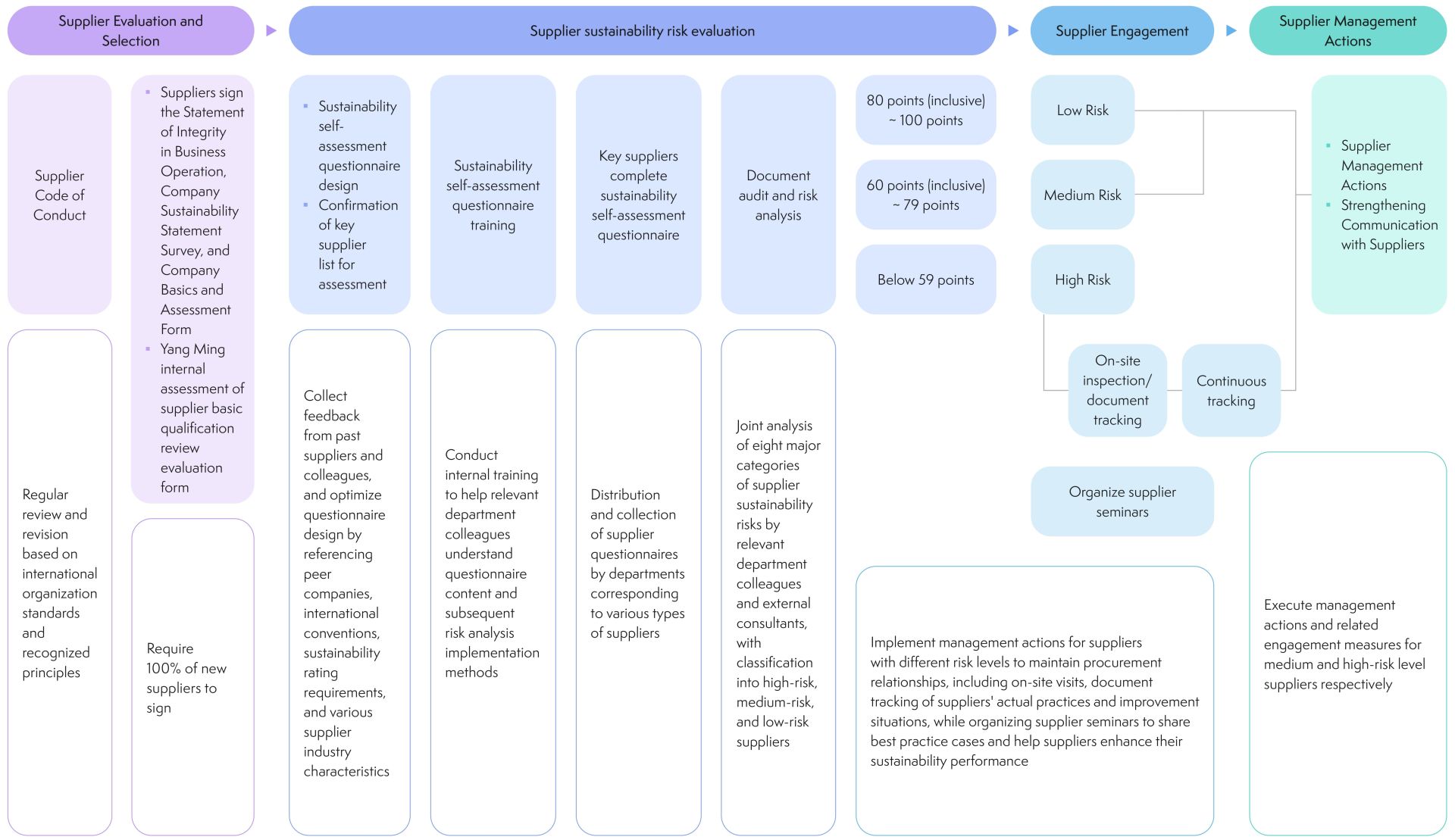
Supply Chain Management Process
Sustainability Risk Evaluation
In 2024, the Company identified 159 key suppliers based on full-year 2023 procurement data and conducted supplier sustainability risk assessments by distributing sustainability self-assessment questionnaires. The questionnaire structure is divided into three major parts: "General Questions," "Industry-Specific Questions," and "Open-Ended Questions," developing 15 sustainability topics across 3 major dimensions of governance, environment, and social, inviting key suppliers to complete sustainability self-assessment questionnaires to evaluate suppliers' sustainability performance through the questionnaire. The industry-specific questions reference sources such as the eight categories of supplier industry characteristics, international shipping industry guidelines/regulations, and industry high-risk issues to design specialized questions, increasing the questionnaire's discriminative capability. This time, 99 key suppliers responded, including 6 from general affairs and services, 17 from professional services, 8 from marine fuel, 2 from vessels, 28 from safe operation of vessels, 14 from container/chassis/ genset, 22 from shipping-related services, and 2 from container yard machinery, with a response rate of 62.26%, slightly improved from last year's 61.44%.
After conducting written reviews of all 99 key suppliers who responded to the questionnaire, the median score was 72 points. According to questionnaire response results, the non-compliance rates for general questions ESG aspects from high to low were environment (22%), governance (18%), and social (14%). The top three sustainability topics with the most supplier non-compliance were data privacy and information security, water resource management, and greenhouse gas management, indicating that suppliers lack dedicated units and individual management policies for these three issues. Yang Ming will subsequently share relevant best practice management measures for these issues with all suppliers at supplier seminars and promote sustainability knowledge sharing through letters. At the same time, the Company selects some suppliers for on-site visits and provides improvement recommendations to guide suppliers in establishing necessary management measures.
After conducting written reviews of all 99 key suppliers who responded to the questionnaire, the median score was 72 points. According to questionnaire response results, the non-compliance rates for general questions ESG aspects from high to low were environment (22%), governance (18%), and social (14%). The top three sustainability topics with the most supplier non-compliance were data privacy and information security, water resource management, and greenhouse gas management, indicating that suppliers lack dedicated units and individual management policies for these three issues. Yang Ming will subsequently share relevant best practice management measures for these issues with all suppliers at supplier seminars and promote sustainability knowledge sharing through letters. At the same time, the Company selects some suppliers for on-site visits and provides improvement recommendations to guide suppliers in establishing necessary management measures.
Supplier Engagement
To promote supplier engagement, continuously strengthen supply chain resilience, and enhance supplier sustainability capabilities, the Company not only conducts written reviews of sustainability self-assessment questionnaires completed by key suppliers, but also conducts on-site visits to suppliers of specific risk levels starting from 2022. Yang Ming Marine Transport Corp. selected five suppliers as on-site visit targets based on this year's questionnaire analysis results, and discussed non-compliant question status and possible future improvement directions with individual suppliers on-site, sharing existing management practices of benchmark cases. Through on-site visits to suppliers, the Company can gain deeper understanding of supplier sustainability practices and obtain feedback, and provide improvement recommendations after visits, including recording on-site discussion situations and possible future improvement directions, serving as reference for suppliers to enhance their sustainability management practices in the future, working together with suppliers to improve sustainability performance management practices. At the same time, for suppliers not subject to on-site visits, the Company considers engaging with different categories of suppliers as much as possible, requiring four suppliers to respond to non-compliant question status and subsequent improvement situations through written follow-up.
| Year | On-site Visit Numbers | Supplier Categories |
| 2022 | 2 | Shipping-related services (2 companies) |
| 2023 | 5 | Safe operation of vessels (4 companies), container yard machinery (1 company) |
| 2024 | 5 | Safe operation of vessels (3 companies), container yard machinery (1 company), professional services (1 company) |
The Company also holds supplier seminars, collaborating with external consultants to share international sustainable supply chain trends and forward-looking shipping industry topics at meetings, providing supplier partners with case references for management measures on sustainability issues. The 2025 seminar will be held in Chinese and English sessions each, with a total of 76 domestic and international key suppliers participating. Through this seminar, Yang Ming Marine Transport Corp. conveys to supplier partners the belief of " From supply to shared success, embark on a new sustainable voyage with Yang Ming."